
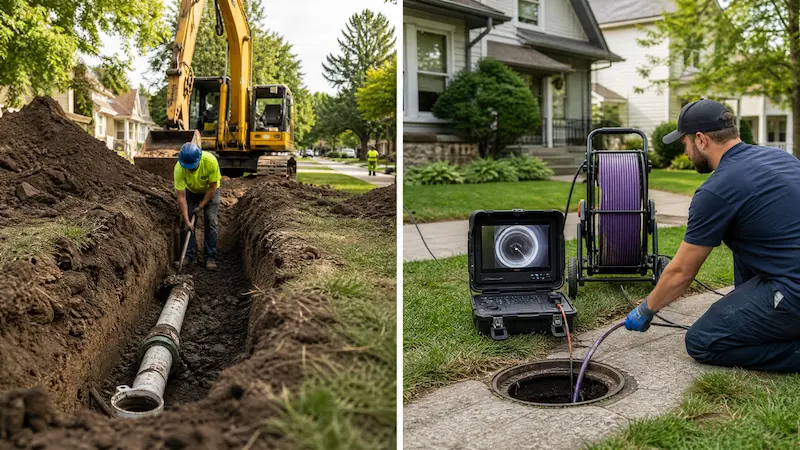
Getting a sewer repair quote is unsettling enough. Getting one that includes the word “excavation” makes it worse. Most Milwaukee homeowners picture a backhoe tearing through their yard, driveway, or landscaping and assume that’s just how sewer repairs work. Sometimes it is. But often it isn’t, and knowing the difference before you agree to anything can save you thousands of dollars and weeks of disruption.
We’ve been doing this work in Milwaukee since 2001, and owner Dave Knight, a Master Plumber with over 25 years of experience, has personally trained every technician on our team. When one of our plumbers walks you through your options, that guidance comes from someone who understands both methods and the conditions specific to Milwaukee soil, infrastructure, and housing stock. Here’s what you need to know before making this decision.
Why Milwaukee’s Soil & Aging Pipes Make Sewer Problems Inevitable
Milwaukee’s geology works against underground pipes in ways homeowners rarely consider until something goes wrong. The city sits on clay-heavy soil that expands when wet and contracts when it freezes, creating constant pressure against buried pipe walls. Most winters, frost penetrates 48 to 60 inches below grade. In older neighborhoods, many sewer laterals were installed at only 36 inches of depth. Right in the zone of maximum freeze-thaw movement.
Neighborhoods like Shorewood, West Allis, and Wauwatosa were largely developed before 1950. Homes in these areas commonly still have their original clay or cast iron sewer laterals, now 70 to 120 years old. Those pipes were never designed to last this long under these conditions, and the stress shows in the form of cracks, root intrusion, joint separation, and partial collapse.
One fact that changes how homeowners think about urgency: according to the City of Milwaukee Department of Public Works, property owners own the sewer lateral from their home all the way to the sewer main, including the point of connection. The city is only responsible for the main itself. Repairs anywhere along that line are your financial responsibility, and delaying them doesn’t make the problem smaller.
How Traditional Sewer Repair Works & When It Makes Sense
Traditional open-trench repair is exactly what it sounds like. A crew digs a continuous trench along the full length of damaged pipe, removes the old pipe, installs new pipe, backfills the trench, and then restores whatever surface was above it: re-pouring a concrete driveway, replanting landscaping, or replacing a sidewalk section. The pipe work itself typically takes one to three days for a residential lateral. In Milwaukee, frost depth requirements mean excavation goes deeper than in warmer markets, which adds both time and cost to any winter or early spring job. Surface restoration is a separate project that happens after the pipe work is done.
Traditional excavation is sometimes the only viable path. Two situations clearly require it:
- Fully collapsed pipe: If there’s no intact channel remaining inside the pipe, there’s nothing for a liner or bursting head to pass through. The old pipe has to come out.
- Severe misalignment or offset: When sections of pipe have shifted significantly out of alignment, correcting the grade requires physical access to the pipe, which means digging.
Outside of those two scenarios, the case for excavation often comes down to habit rather than necessity.
How Trenchless Sewer Repair Works & What It Protects
Trenchless methods repair or replace a damaged pipe from the inside, requiring only two small access points rather than a full trench running the length of your yard. There are two primary techniques, and understanding both helps you ask better questions of any plumber quoting your job.
CIPP Lining
CIPP stands for cured-in-place pipe lining. A flexible liner coated in resin is inserted into the damaged pipe, inflated against the pipe walls, and cured in place, creating a seamless new interior surface inside the old pipe. The damaged pipe becomes a shell around a structurally sound new one.
Pipe Bursting
Pipe bursting pulls a new HDPE pipe (high-density polyethylene, a flexible and highly durable plastic) through the old pipe using a bursting head that fractures the old pipe outward into the surrounding soil as the new pipe follows behind it. The old pipe is destroyed in place; the new pipe takes its position.
Both HDPE and CIPP liners resist corrosion and handle soil movement without cracking. Their flexibility makes them significantly better suited to Milwaukee’s freeze-thaw soil conditions than rigid clay or cast iron, and manufacturer ratings on these materials run 50 years or more. For homeowners with mature trees, established landscaping, or a driveway running over the sewer line, trenchless repair eliminates the cost of tearing out and restoring those surfaces entirely. The yard looks the same after the repair as it did before.
How to Know Which Method Is Right for Your Home
The honest answer is that you can’t know without a video camera inspection. A camera run through your sewer lateral identifies the type of damage, the pipe material, where breaks are located, and whether an intact channel exists for trenchless access. Without that information, any recommendation is a guess. We use video camera inspection on every sewer assessment we perform, which removes the guesswork and gives you a clear picture of what’s actually happening underground before any repair decision is made.
Here’s a general framework for interpreting what an inspection reveals:
- Cracks, corrosion, root intrusion, or partial collapse with an intact channel: These are strong candidates for trenchless repair. CIPP lining or pipe bursting can address all of these without excavation.
- Full collapse or severe pipe offset: Traditional excavation is likely required. The pipe needs to be physically corrected before a liner or new pipe can be placed.
- Combined sewer area or shared lateral: Roughly one-third of Milwaukee and about half of Shorewood have combined sewers, where stormwater and sanitary flows share the same pipe. These situations add complexity to the diagnosis and repair scope, and they benefit especially from an experienced local assessment.
The Real Cost Comparison: What Excavation Quotes Leave Out
Trenchless repair often carries a higher upfront price than traditional excavation. That comparison looks very different once you account for what excavation actually costs in total. Traditional repair triggers a cascade of secondary expenses: concrete removal and re-pouring, lawn and soil restoration, landscaping replacement, and sometimes sidewalk or curb work if the line runs under a public right-of-way. Those costs aren’t always broken out clearly in an initial quote, and in many cases they equal or exceed the pipe repair cost itself. On timeline, trenchless repair for most residential laterals completes in a single day, while traditional excavation runs one to three days for the pipe work plus additional time for surface restoration.
Milwaukee-area homeowners also have access to financial assistance that many aren’t aware of. The Metropolitan Milwaukee Sewerage District (MMSD) offers incentives through its Pipe Check program for sewer lateral repair and replacement, including coverage for CIPP lining from under the home to the connection at the sanitary sewer mainline. The City of Milwaukee, in partnership with MMSD, also operates a Citywide Lateral Replacements program for owner-occupied properties with defective laterals and outstanding code violations. Incentive availability and eligibility can change, so confirm current details directly with MMSD before finalizing your repair plan.
Getting the Right Answer for Your Home
There’s no universally correct method. The right choice depends on what your pipe actually looks like, where it runs, what’s above it, and what condition it’s in. We provide upfront, transparent pricing after every inspection so you know exactly what each option costs and why we’re recommending it. Same-day appointments are available for urgent situations, and our fully stocked trucks arrive ready to work. If you’re weighing your options after a concerning inspection or an unexpected sewer issue, Knight Plumbing & Drain Cleaning is ready to help. Give us a call at (414) 250-0650 and we’ll start with a real look at what’s going on.